
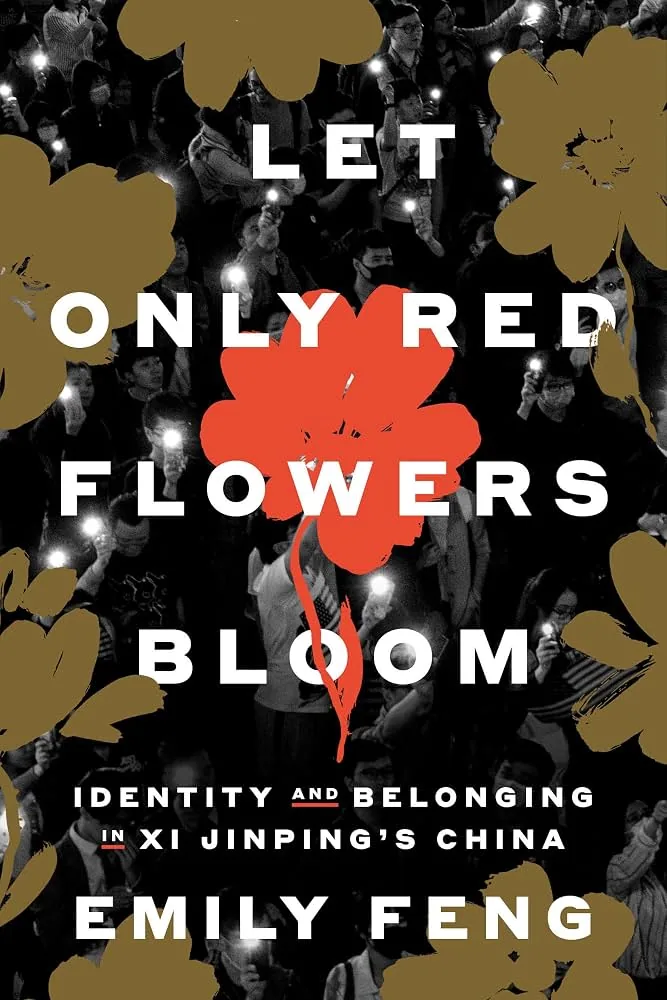
Let Only Red Flowers Bloom: Identity and Belonging in Xi Jinping’s China
by Emily Feng
Book Club Date:August 2026
📖 Book Summary
A garden filled with red, white and blue flowers is perfectly natural. But what happens when the gardener decides that red is the only acceptable colour? The other flowers may find themselves denied even the right to grow. In Let Only Red Flowers Bloom: Identity and Belonging in Xi Jinping’s China, Chinese American journalist Emily Feng uses this imagery to explore identity and political control in contemporary China. The book’s title also carries a historical irony. Mao Zedong once introduced the slogan “Let a hundred flowers bloom, let a hundred schools of thought contend”, using flowers as a metaphor for diverse ideas and voices. Yet when the Anti-Rightist Campaign began in 1957, many who had previously voiced criticism found themselves persecuted. Drawing on this history, Feng portrays contemporary China as a garden where only red flowers are permitted to bloom. Red symbolises the ruling Chinese Communist Party, while the other colours—representing different ethnic groups, languages, faiths and ideas—may be treated as branches that need pruning.
✍️ Reading Notes
What makes this book particularly compelling is the way it brings sweeping political questions into the everyday lives of ordinary people. When a state attempts to define who counts as a “real Chinese person”, its criteria can extend into almost every aspect of daily life. A person’s ethnic background, language, religious beliefs, political expression and even online posts may become measures of their loyalty. The Uyghurs, Mongolian teachers and Hui Muslims featured in the book face different circumstances, yet their stories reveal how culture and identity can gradually be constrained by government policies. Human rights lawyers, entrepreneurs caught up in political campaigns and online creators subjected to censorship reveal another side of the same problem: even those who believe in the law, support their country or have once enthusiastically embraced the system can eventually become inconvenient in the eyes of the very system they supported. This is why the most unsettling aspect of these stories is not necessarily the intensity of anyone’s resistance, but the fact that many of them never intended to oppose the state in the first place. Some simply want to do their jobs well. Others want their children to continue learning their mother tongue, hope to publish books, or believe that the government should abide by the laws it has established. Their affection for their country may remain intact, and their sense of identity may not have changed at all. The conflict emerges when their personal lives and convictions can no longer fit within the framework imposed by the state. In an interview with Radio Free Asia (RFA), Feng explained that she hoped readers would use these personal stories to understand how major political developments affect real people. Having reported on China for years, she has a deep personal connection to the country. Many of the people she documents also continue to identify as Chinese. This makes the book’s central question all the more complicated: when someone still loves their country but is no longer accepted by it, how are they supposed to understand where they belong? These questions became particularly tangible in July 2026, when Hong Kong police searched two independent bookshops and arrested five people on suspicion of displaying and selling seditious publications. Media reports at the time suggested that Let Only Red Flowers Bloom might have been among the books under investigation, although the Hong Kong authorities did not publicly identify the specific titles involved. The incident attracted considerable attention in Taiwan. The Traditional Chinese edition temporarily sold out, prompting the publisher to rush-print an additional 10,000 copies. The incident highlights a peculiar irony: a book documenting censorship and restrictions on freedom of expression attracted even more attention after it was suspected of becoming a target of censorship itself. The experiences of the bookshops, the books and their readers seemed to extend the very issues explored within its pages into the real world. When the public sale of a book can itself become a political issue, we have to ask: which passages are those in power afraid of? Or is what truly unsettles them the possibility that people might encounter different stories and reach their own conclusions? Taiwanese readers may wish to pay particular attention to the chapters concerning Taiwan and people seeking asylum. Some reviewers argue that, while Feng’s focus on Chinese identity helps illuminate the experiences of Chinese dissidents and exiles, it may also push Taiwan’s own historical experience, political agency and contemporary realities into the background. This is a criticism worth taking seriously, though it need not be accepted as the final word. After all, a book can expose how power oppresses people while still having its own blind spots in the selection of subjects, allocation of space and interpretation of history. Opposing censorship does not mean we should stop examining an author’s narrative choices. Nor does sympathising with the oppressed mean that everyone’s identity and political experience can be neatly fitted into the same framework. Perhaps the most valuable tension to bring into a book club discussion is precisely this: identity has many layers, yet a state may try to reduce it to a single, standardised answer. When political power begins dictating which language people should speak, which values they should believe in and how they should understand their own past, everyday life gradually becomes an examination in which everyone must constantly monitor and correct themselves.
💬 Discussion Points
- 1Who has the right to define a person’s identity? When personal identity, cultural heritage and state expectations come into conflict, who should decide what it means to be a “real Chinese person”?
- 2Why do language, culture and publishing become political issues? When a government seeks to standardise language, restrict religious practices or censor books, is it simply managing social order, or is it reshaping how people understand themselves?
- 3How should we read a work of narrative journalism with a distinct perspective? Can we agree with its criticism of authoritarian control while still questioning how it portrays identity in Taiwan, Hong Kong and China? When reading, how can we distinguish between the experiences of interviewees, the author’s interpretation and the broader historical context?