
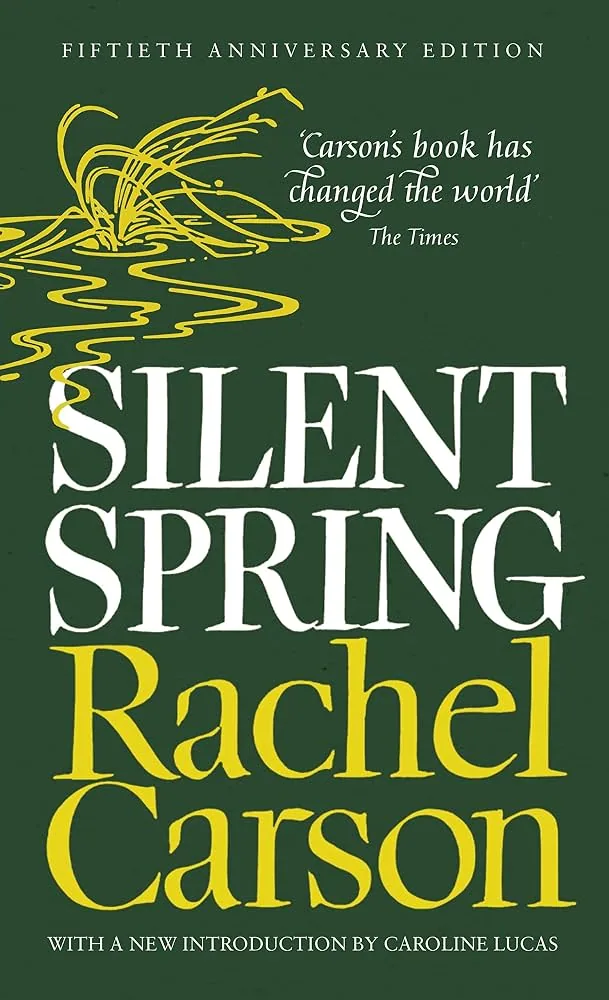
Silent Spring
by Rachel Carson
Book Club Date:August 2026
📖 Book Summary
What would spring sound like if the birds stopped singing? Published in 1962, Rachel Carson’s Silent Spring challenged the widespread use of chemical pesticides, particularly DDT, and revealed how these substances could travel through food chains, accumulate in living organisms and disrupt entire ecosystems. Combining scientific research with accessible prose, Carson helped the public understand a fundamental truth: nature is an interconnected system, and the consequences of human actions rarely stop where we expect them to. The book became a landmark in the modern environmental movement, changing public attitudes towards pesticides and contributing to subsequent environmental regulation.
✍️ Reading Notes
One of the most striking ideas in Silent Spring is how a seemingly local action can trigger consequences far beyond its immediate surroundings. Imagine a tree sprayed with pesticides. The chemicals may remain on its leaves, enter the bodies of earthworms feeding on fallen leaves, and eventually reach robins that eat those worms. What begins as an attempt to eliminate unwanted insects can travel through the food chain, affecting species that were never the intended targets. This is the ecological perspective Carson asks us to adopt. We often treat nature as a collection of separate problems: pests to eliminate, weeds to remove and diseases to control. Yet ecosystems operate through complex relationships. Interfering with one part can set off a chain of consequences elsewhere. Carson also challenges our desire to control nature through technological solutions. Chemical pesticides can offer immediate results, but widespread use may contribute to pesticide resistance, harm non-target species and create environmental damage that becomes apparent only over time. The question, then, is not simply whether a chemical works, but what else it does—and who ultimately bears the cost. This brings us to a question that remains relevant today: Who gets to decide what counts as safe? A substance may be considered useful because it increases agricultural productivity or controls disease. Yet its long-term effects on wildlife, ecosystems and human health may take years to become clear. When the benefits are immediate but the risks are uncertain, how should society make decisions? And who should bear the burden of proving that a substance is safe? It is worth noting that Carson did not advocate banning every chemical pesticide. Her criticism focused on indiscriminate use, particularly of persistent chemicals such as DDT. She argued for more careful application, stronger regulation and alternatives such as biological pest control. DDT illustrates the complexity of this debate. It was widely used to control insects, including those that transmit malaria and typhus, but its extensive use also raised concerns about environmental persistence, ecological harm and pesticide resistance. The United States cancelled most uses of DDT in 1972, while international restrictions later established under the Stockholm Convention retained a limited exemption for certain disease-vector control purposes. Its history reminds us that a chemical’s usefulness does not settle the question of whether its risks are acceptable. More than six decades after Silent Spring was published, Carson’s questions remain relevant. Contemporary research continues to investigate the effects of pesticides on terrestrial wildlife and biodiversity. Meanwhile, debates surrounding persistent chemicals such as PFAS echo some of the concerns Carson raised about substances whose effects can extend far beyond their original use. PFAS and DDT are different groups of chemicals, but both remind us of the importance of understanding long-term environmental consequences before damage becomes widespread. Perhaps the most enduring lesson of Silent Spring is that scientific progress requires more than the ability to invent powerful tools. It also requires the willingness to question how those tools are used, acknowledge what we do not yet know and take responsibility for consequences that may not be immediately visible. A silent spring is a haunting image, but it is also a warning. By the time we notice that something essential has disappeared from the natural world, the damage may already have been unfolding for years.
💬 Discussion Points
- 1Agriculture vs. ecology: How should we balance the need for agricultural productivity with the protection of ecosystems? Who should bear the cost of reducing pesticide use?
- 2The burden of proof: When a chemical’s long-term effects are uncertain, should it be considered safe until evidence of harm emerges, or should its use be restricted until sufficient evidence of safety is available?
- 3Have we learned from history? Despite decades of environmental research and regulation, controversies over potentially harmful chemicals continue to emerge. What makes it so difficult to turn scientific knowledge into effective action?